On June 13, 2012, at 9 A.M., the California Court of Appeals, Second Appellate District Court, Division 3, at 300 South Spring Street, Los Angeles, will hear oral argument on the use of Parental Alienation Syndrome ("PAS") in child sexual abuse cases in McRoberts v. Los Angeles Superior Court, Case No. B234877.
Patricia J. Barry, attorney for Sera McRoberts, will present oral argument on the violations of due process and equal protection that Sera McRoberts and her children experienced during the trial on the two daughters' allegations of sexual abuse against their father, Steve Lesserson. Ms. Barry argued and won the first sexual harassment case before the U.S. Supreme Court in Merritor vs. Vinson. The Amicae (several national domestic violence organizations and California Senator Sheila Kuehl having signed on) are represented by Erica Reilley of Jones Day who will present oral argument on the lack of scientific validity and inadmissibility of evidence of PAS.
The National Council of Juvenile and Family Court Judges, The American Psychological Association and the American Psychiatric Association have rejected PAS as both unscientific and failing to meet evidentiary standards. It is not listed in any of the Diagnostic and Statistical Manuals. Yet, Stan Katz, Custody Evaluator and Expert Witness of the infamous McMartin Preschool Trial and the Michael Jackson molestation cases, used PAS against Sera McRoberts to change custody to Mr. Lesserson, despite the fact that one of the daughters had contracted a sexually transmitted disease.
Some Rhode Island judges still lend credence to PAS, which was featured in the Bar Association's 2004 Guardian ad Litem Training Manual and as recently as the April/May 2012 issue of the Rhode Island Bar Journal.
For a pdf of the McRoberts Amicus Brief, send an email to ParentingProject@ verizon.net with "Amicus Brief" in the subject line.
For further information, contact Patricia J. Barry, Attorney, 213-995-0734, pbarrylegal@gmail.com
AddThis


Wednesday, June 6, 2012
Thursday, May 31, 2012
The Curious Case of Robert Karns

The first order of the day was to be certain the witness chair would not collapse under a succession of personal injury lawyers. Some of the twenty-odd chairs in the Disciplinary Board's modest hearing room are, in fact, broken. (The room is ominously lined with file boxes from lawyers whose businesses they have closed. I wondered if the chairs were donated by those offices.)
Disciplinary Board member Attorney Laura A. Pisaturo hauled over a green captain's chair and tried it out herself before offering it to a witness. She took her seat at the hearing table with Attorney Matthew L. Lewiss, who chaired the hearing, and Public Member John E. Moran III, who verified for the record that he is not related to the complainant, Louise Moran.
Deputy Disciplinary Counsel Barbara Margolis represented Ms. Moran, who attended with her private attorney. Based on the exhibits and testimony, this appears to be the chronology of the case:
- On January 31, 2012, Rhode Island construction worker William Moran died of carbon monoxide exposure, and others were injured in a West Virginia hotel.
- The next day, West Virginia Attorney Michael Bee called Rhode Island Attorney Robert Karns (who knew him from their work on traumatic brain injury cases) and asked Karns to find out about the Rhode Island victims since Bee was working on a lawsuit. Karns was in the middle of an IT seminar, but he called Investigator Ryan McCormack and asked him to look into the case and to provide victims with Attorney Bee's website and with Attorney Karns's business card.
- On February 3rd, McCormack went to the home of Mr. Moran's widow, Louise Moran. She was not at home, but McCormack talked with a family friend, Randolph Baker, who told McCormack to return and speak to Moran.
- On February 7th, after the funeral, McCormack returned to the Moran home, and Ms. Moran told him she had hired another lawyer.
- A week later, on February 14th, Moran wrote a letter of complaint against Karns to David Curtin, Chief Disciplinary Counsel. Her letter arrived on February 21st.
- On February 27th, Mr. Karns wrote to Mr. Curtin, admitted his violation of Rule 7.3, and apologized.
- More than three weeks later, on March 21st, Curtin petitioned the Disciplinary Board to hear the case.
- On March 28th, Karns's attorney Amato A. DeLuca filed his client's answers to Mr. Curtin's Petition.
At the hearing, DeLuca called on several colleagues of "Respondent-attorney" Karns to testify under oath to his character. Some had been his opponents in the courtroom, but all spoke highly of his integrity, hard work, and generosity. One said she believed he was simply doing what he could to help a member of the Bar from another jurisdiction. "That's Bob," she said, describing his "selfless" attitude: "Whatever you need, I'll help you out."
After more lawyers praised Karns, Louise Moran, who sat next to me, grumbled to her private attorney, "This is ridiculous." Five lawyers testified to the respondent's decency, and one asserted that it was not Karns, but Ms. Moran's attorney who was pursuing this "for pecuniary gain." (After that witness returned to his seat, Ms. Moran's attorney summoned him to the corridor, where a separate commotion ensued.)
Finally Mr. Karns took the witness chair and told how he had phoned McCormack during a break in his seminar and asked the investigator to "look into" the case, but he had no idea McCormack was returning to the Moran home a second time. McCormack was a thorough and "dogged" investigator, said Karns. Before leaving the chair, Karns apologized to everyone in the room, and most emphatically to the widow.
She took the witness chair next -- a youthful woman, in her 30s or 40s, and told about receiving lawyers' solicitations by mail -- perhaps thirty of them -- which she immediately discarded. Those are entirely legal under Rule 7.3, which prohibits soliciting prospective clients in person or by telephone ("real-time contacts"), but permits mailings.
There was a lot that was curious about this hearing:
- The essential witnesses -- Mr. Baker and Mr. McCormack -- never appeared. Only they could clear up what Karns said to McCormack, what was said on the first visit to the Moran home, and whether Baker had asked McCormack to return. That degree of hearsay calls the entire proceeding into question.
- Was the West Virginia lawyer proposing a class action suit? Given the circumstances of the case, this seems likely, and it might have left some wiggle room under Rule 7.3 that Karns did not exploit.
- And what about that extraordinary apology? Even Karns's lawyer said he would not have counseled his client to apologize if he had represented Karns then. But if someone is truly harmed, an apology matters.
In “The
Art and Power of the Apology” Sarah Kellogg notes that attorneys who make their living at medical malpractice "are suspicious of [apologies] because they see their cash cow breaking free of the barn and running down the lane."* Yet here was the patriarch of an entire family of malpractice lawyers (Karns's two daughters, son, and son-in-law all practice in his firm) offering his own abject apology.
Even if Karns's apology was a cynical attempt to deflect the Disciplinary Counsel, it is hard to understand how the case ever came to demand the public money and time devoted to this proceeding when Family Court attorneys commit wholesale violations of the Rules of Professional Conduct (as I have found researching countless child custody cases) without ever facing disciplinary proceedings or judicial reprimands.
This appears to have been the complaint of a woman who attended the hearing and disrupted it at the end by calling the entire Bar Association to task. (I was so stunned by her outburst that I failed to take notes, but Ms. Margolis rushed to bring Mr. Curtin into the hearing room, and Mr. Lewiss hastily adjourned the hearing.)
Later Curtin observed with amazement that this woman wonders why she "lost custody of a child who isn't even hers."
I learned there is more to her case than that, and her bizarre behavior is far more understandable in context. I have met many parents -- and stepparents -- who have been traumatized by the unaccountable behavior of Family Court lawyers in violation of Rule 8.4 (c) against engaging "in conduct involving dishonesty, fraud, deceit or misrepresentation" -- like those who tormented the child pictured at the top of this blog, or others I have written about in http://littlehostages.blogspot.com and http://trophychild.blogspot.com
I asked Mr. Curtin a few weeks ago if the Disciplinary Counsel's Office can identify the most common complaints against Family Court lawyers. He said it is impossible to know, since his office does not keep a record of the types of complaints in various courts. I have written to ask Mr. Curtin to have his office compile a simple database that would show the full range of public concerns about the behavior of attorneys, the Rules they are accused of violating, and the Courts where this alleged behavior occurred.
When I met with him, Mr. Curtin spoke of his efforts to uplift the profession and to help lawyers deal with destructive patterns in their personal lives and practices rather than simply function in a punitive role. This is an important goal for his Office.
I am not a lawyer and do not know Mr. Karns. But the case against him appears unreasonable and punitive. In what universe did this rise to the top of lawyers' offenses? If police were content to set unreasonable speed traps to boost their statistics but failed to address violent crimes within the community, we would cry foul.
Deputy Counsel Margolis described the procedure ahead: the hearing panel will meet to decide on a sanction which they will recommend to the full Disciplinary Board with a written decision. The Board will forward their recommendation to the Supreme Court that will issue an Order -- probably sometime in the fall.
This seems like a good time for the Supreme Court to direct its Disciplinary Counsel to focus on those violations that most egregiously damage the honor of Rhode Island's legal profession -- including "dishonesty, fraud, deceit or misrepresentation" forbidden by Rule 8.4 (c).
Even if Karns's apology was a cynical attempt to deflect the Disciplinary Counsel, it is hard to understand how the case ever came to demand the public money and time devoted to this proceeding when Family Court attorneys commit wholesale violations of the Rules of Professional Conduct (as I have found researching countless child custody cases) without ever facing disciplinary proceedings or judicial reprimands.
This appears to have been the complaint of a woman who attended the hearing and disrupted it at the end by calling the entire Bar Association to task. (I was so stunned by her outburst that I failed to take notes, but Ms. Margolis rushed to bring Mr. Curtin into the hearing room, and Mr. Lewiss hastily adjourned the hearing.)
Later Curtin observed with amazement that this woman wonders why she "lost custody of a child who isn't even hers."
I learned there is more to her case than that, and her bizarre behavior is far more understandable in context. I have met many parents -- and stepparents -- who have been traumatized by the unaccountable behavior of Family Court lawyers in violation of Rule 8.4 (c) against engaging "in conduct involving dishonesty, fraud, deceit or misrepresentation" -- like those who tormented the child pictured at the top of this blog, or others I have written about in http://littlehostages.blogspot.com and http://trophychild.blogspot.com
I asked Mr. Curtin a few weeks ago if the Disciplinary Counsel's Office can identify the most common complaints against Family Court lawyers. He said it is impossible to know, since his office does not keep a record of the types of complaints in various courts. I have written to ask Mr. Curtin to have his office compile a simple database that would show the full range of public concerns about the behavior of attorneys, the Rules they are accused of violating, and the Courts where this alleged behavior occurred.
When I met with him, Mr. Curtin spoke of his efforts to uplift the profession and to help lawyers deal with destructive patterns in their personal lives and practices rather than simply function in a punitive role. This is an important goal for his Office.
I am not a lawyer and do not know Mr. Karns. But the case against him appears unreasonable and punitive. In what universe did this rise to the top of lawyers' offenses? If police were content to set unreasonable speed traps to boost their statistics but failed to address violent crimes within the community, we would cry foul.
Deputy Counsel Margolis described the procedure ahead: the hearing panel will meet to decide on a sanction which they will recommend to the full Disciplinary Board with a written decision. The Board will forward their recommendation to the Supreme Court that will issue an Order -- probably sometime in the fall.
This seems like a good time for the Supreme Court to direct its Disciplinary Counsel to focus on those violations that most egregiously damage the honor of Rhode Island's legal profession -- including "dishonesty, fraud, deceit or misrepresentation" forbidden by Rule 8.4 (c).


Monday, May 21, 2012
Mary Kennedy: Death by Court-ing

Mary Richardson Kennedy hung herself last week, reports Mail Online: "Court records show that as well as battling with debts and depression, she was also fighting a losing battle with her estranged husband as he relentlessly built a case against her in their custody battle.
"The son of the late Sen Robert F. Kennedy, he filed temporary restraining orders against Mary that a Westchester judge signed on March 28, April 19 and again last Friday, documents show.
"He also filed an order of protection last September and got another judge to hold her in contempt of court later that month, according to the Post."
At other times, the article reports, he praised her as "extraordinary," but he used the court to control her by filing multiple restraining orders. He tried to get full custody of the children by claiming she was unfit while he publicly replaced her with his actress girlfriend, Cheryl Hines.
Read more: http://www.dailymail.co.uk/news/article-2146356/Mary-Kennedy-death-Robert-Kennedy-Jr-reveals-ex-wifes-life-long-struggle-depression.html#ixzz1vV6bPz4Q
Tuesday, May 15, 2012
How federal funds influence family courts and harm children

In a report by Anne Stevenson, Huffington Post notes that the top five federal HHS programs endanger women and children:
The Personal Responsibility and Work Opportunity Reconciliation Act of 1996 and the Temporary Aid to Needy Families (TANF) program it created transformed welfare policy by drastically reducing and shifting federal assistance away from the homes of mothers and children and into the homes of violent offenders. In an article entitled "How Federal Welfare Funding Drives Judicial Discretion in Child-Custody Determinations and Domestic Relations Matters" fathers and rights activists Lary Holland and Jason Bottomsly explain that this policy has backfired because the incentives are structured so that the state will only benefit if children are removed from loving homes:
"In essence, the federal guidelines wanted the states to function as collection agencies, recovering financial support from parents who had willfully abandoned their parental responsibilities to their children. The result, however, was different from the intent and has caused the state welfare programs to adjust their environment to have a greater need, which has caused the program to collect from willing parents that would ordinarily provide a loving environment for their children absent a court order limiting a parent's involvement. Despite the original intent of the IV-D welfare program, it now provides an incentive for the states to use their family courts to produce forcibly absent parents in order to increase the states' IV-D welfare caseload."
The bureaucratese is hard to fathom, but the outcome--removal of children from loving homes--is exactly what we have been watching in Rhode Island Family Court over these years.
For more on those five programs, see the article at http://www.huffingtonpost.com/anne-stevenson/top-5-hhs-programs-endang_b_1511613.html
We need the Rhode Island General Assembly to get some clarity with an objective audit of the role of federal funds in removing children from loving homes, taking them into state custody, and even awarding sole custody to the abusive parent.
Wednesday, April 25, 2012
Hen's teeth and heroes

It was odd last month when the Rhode Island Supreme Court's Disciplinary Counsel David Curtin reportedly filed a complaint accusing Attorney Robert T. Karns of unethical conduct for twice offering his services to a tragically bereaved widow (Tracy Breton, “Lawyer faces disciplinary hearing,” The Providence Journal, March 30, 2012, Section: Rhode Island; Page A5 COURTS).
Mr. Karns’s representatives had barely rung that doorbell twice. There was no contract, no litigation. He apparently admits he violated Rule 7.3 of the Rules of Professional Conduct that prohibits lawyers from soliciting prospective clients.
His offense seems minor compared to years of Family Court litigation full of blatant violations that have removed parental rights with no due process, no notice, no hearing, no evidence, no cross examination—all done in the usual way, ex parte, through so-called “emergency” orders when no emergencies existed, sometimes with DCYF involvement and behind closed doors.
Mr. Karns’s offense does not compare to the lifelong damage done to traumatized children by lawyers in cases I have written about at http://LittleHostages.blogspot.com, http://TrophyChild.blogspot.com, and http://CustodyScam.blogspot.com
Based on those cases, I had long ago concluded that the Supreme Court’s Disciplinary Counsel and Rhode Island’s Rules of Professional Conduct have less bite than a hen’s teeth.
I plan to attend Mr. Karns’s hearing at the Office of the Disciplinary Counsel, 24 Weybosset Street, 2nd floor, Providence, on Monday, May 21st at 3 pm to gain some understanding of what needs to be done to end the wholesale violations going on in Family Court and in DCYF.
Meanwhile, I will look again at the record of the current “Trophy Child” case, http://TrophyChild.blogspot.com, where three attorneys, Cynthia Gifford, Cherrie Perkins, and Kerry Rafanelli, allegedly violated Rule 8.4 of the Rules of Professional Conduct http://www.law.cornell.edu/ethics/ri/code/RI_CODE.HTM
Finally, we need heroes, not hen’s teeth. So it is good to know that the Bar in Texas (where the election of judges still inclines the scales of justice toward campaign contributors) that Talmage Boston has produced a book of positive role models “reestablishing the legal profession’s once hallowed reputation”--Raising the Bar: The Crucial Role of the Lawyer in Society http://texasbarbooks.net/books/raising-the-bar/.

Thursday, April 19, 2012
Order in the Court

Yesterday I sat in an unusual courtroom in Providence Family Court. I was alone. There was something different about the space that took me a while to absorb. What was it?
My eyes lingered over the dark wood paneling, the carpets, seats for litigants, lawyers, the public, the judge's bench, the witness stand extending to one side, the clerk's desk to the other: solid, warm, even reassuring. What was I noticing?
I recall the first time I entered a courtroom in Rhode Island Family Court over two decades ago--how chaotic it was full of people. Something seemed incongruous. What was it?
Then I remembered: Taped to the paneling behind the clerk were photos of her family and some children’s drawings. The stenographer had mounted family pictures, too.
I had not thought of the significance then, but it seemed inappropriate. Had Rhode Island privatized its public courtrooms into office cubicles? This was one of my earliest introductions to our state’s small-town culture in Family Court.
I’m sure the people who put up their pictures were good-hearted. They may have felt it would humanize the space to see family photos on the wall. They did not intend to communicate any subliminal message about who you need to know to protect your children in this Court.
I did not fully appreciate how unsettling those family photos were until yesterday, when I sat in a courtroom without them.
I have seen courtrooms in Family Court with bouquets of flowers on the bench--perhaps to make the setting less austere for people who find this place deeply traumatic. I have seen candy bowls and lollypops for children getting adopted. (I don't remember if the judge offered candy at our son's adoption, but I do remember his clarity in saying: This child has all the rights of any child born to you. That was sweetness enough for us.)
In one Rhode Island courtroom I saw a statue of the blindfolded Lady Justice holding the scales aloft. I even saw a judge's omerta-warning taped to the bench--Silence is Golden.
But the courtroom yesterday took my breath away with its uncluttered simplicity. Behind the judge's bench at either side stood the only decoration a courtroom needs: the flag of our country and the flag of our state.
A courtroom whose judge upholds our laws with justice and mercy needs nothing else.
Tuesday, April 10, 2012
Chief Judge Bedrosian is changing the rules
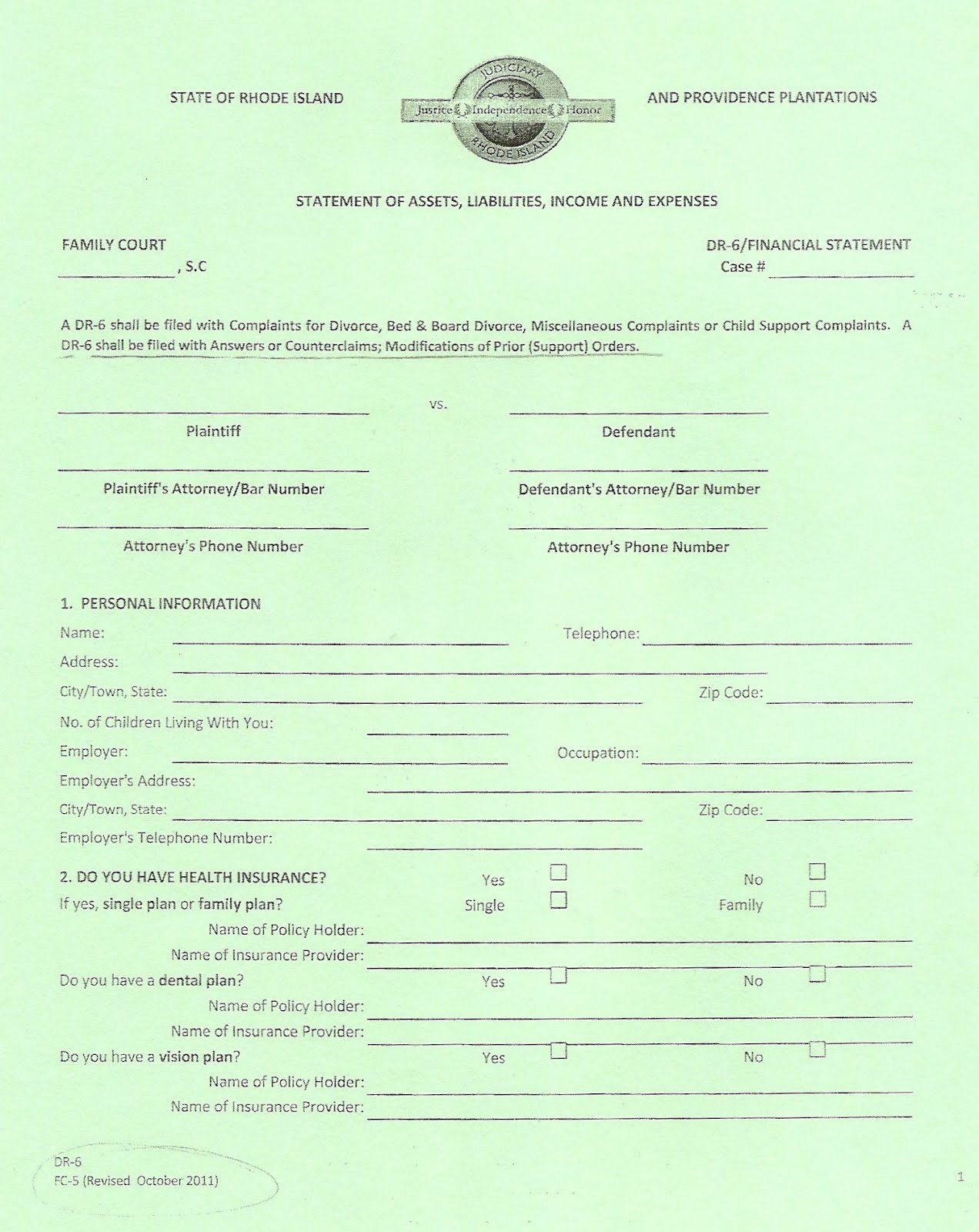
(Click once to enlarge.)Last week I went to Providence Family Court to observe a hearing in the "Textron Case" (mentioned in my post of March 16, 2012). I learned about another reform of Chief Judge Haiganush Bedrosian -- a new 9-page green version of the old "DR6," the financial form that has been the object of much lawyerly gaming in the past (as the baby shown at the top of this blog discovered in her teens, but that's another story).
No one in the courtroom seemed to have one of these new DR6 forms, but the fact that the Defendant’s attorney knew the form should have been submitted -- and the judge agreed -- suggested that a new wind is blowing.
In the Washington County case that I have been reporting at http://TrophyChild.blogspot.com, "Barbara," the client of Cynthia Gifford and Cherrie Perkins, submitted one incomplete DR6 in four years and failed to include the amounts of her financial resources in that skimpy 2-page document.
Six months ago, Chief Judge Bedrosian promulgated the new rule that requires the green 9-page DR6 to be filed with each Miscellaneous Complaint, Answer, Counterclaim, etc. The color makes it easy to find in the file and hard to fraudulently create without the client's freshly notarized signature.
This strikes me as an important reform. Detailed financial reporting always seemed like a no-brainer that could have avoided hundreds of costly hours wasted in this Court. Chief Bedrosian's reform could seriously crimp the freewheeling style of many Family Court attorneys. It could greatly reduce the number of frivolous motions that now clog the Court.
Another of Chief Bedrosian's reforms makes my work harder, but protects the process against documents mysteriously disappearing or getting hopelessly jumbled in court files. Under this reform, those viewing the file can still copy documents, but may no longer remove the prongs holding them in the file.
It is difficult and expensive to make clear copies of thick files on a photocopier. I could not have figured out the legal abuse in the current TrophyChild case without scanning every document in the public files.
Hopefully Family Court will move toward electronic data, much like the federal courts, which could greatly simplify the filing and retrieval of documents.
I am glad to endure any reforms that mean Family Court is becoming more ethical and just. The three cases I mentioned in this post represent four children--now young women. This month, the youngest (in the Textron Case) turns 12, and the oldest (pictured above) turns 23. I have met them all. Because of them and others like them, I take these reforms personally.
I first opposed Judge Bedrosian at a Judicial Nominating Commission hearing in 1996 because of a decision that she later defended as conforming to the rules. I argued that her decision harmed the child pictured at the top of this blog, a victim of domestic violence. Judge Bedrosian criticized my “ignorance of the requirements of judicial conduct.”
Ironically, her reform of the DR6 hits at the heart of that case and each of the other cases I have mentioned in this post -- the enormous financial inequities that set these three Family Court custody cases on such an unequal playing field. Parents who are forced to litigate pro se, or with pro bono attorneys, seldom prevail for long in this Court.
Their abusers keep returning to assault them again and again. And where will they find the money to appeal to a higher court when decisions harm their children here?
The Court seldom sees these children or how much they suffer. It is good to find Chief Judge Bedrosian addressing problems related to children’s trauma and the bad practices that have prevailed too long in Family Court.
She deserves credit and encouragement to keep working at those parts of this system that are most unjust, including:
1. The abuse of so-called “emergency” motions thatFamily Court needs a roadmap for the countless people struggling to find their way through these labyrinthine rules and procedures that often seem intentionally confusing and inconsistent from one judge to the next. Despite my worst fears, maybe this is exactly the time when we need an experienced teacher in charge.
a. are not true emergencies or that
b. should be referred to Superior Court’s domestic violence court (without placing the financial and emotional burden of legal defense on alleged victims).
2. The abuse of ex parte motions that
a. prevent judges from hearing the other side in a timely manner
and
b. produce orders that spread misinformation in the community.
3. The failure of lawyers to complete paper work in a timely manner
a. when drafting orders after hearings,
b. when submitting documents to the other side for review before getting the judge’s signature, or
c. when completing paperwork for child support.
4. The Court’s use of clinicians that violates
a. HIPAA regulations,
b. ethics of mental health professionals, and
c. rules of the insurance industry against reimbursing for court-ordered services.
5. The need for judges to sanction lawyers under Rule 11 of the Federal Rules of Civil Procedure http://www.law.cornell.edu/rules/frcp/rule_11
Subscribe to:
Posts (Atom)